

Key Takeaways
- A decagon was discovered around Saturn's south pole, indicating complex atmospheric dynamics.
- This shape could provide new insights into Saturn's atmospheric conditions and weather patterns.
- The formation suggests ongoing and dynamic processes within Saturn's atmosphere.
- Understanding these patterns enhances our knowledge of gas giants and their behavior.
- Future missions may further investigate the implications of this decagon formation.
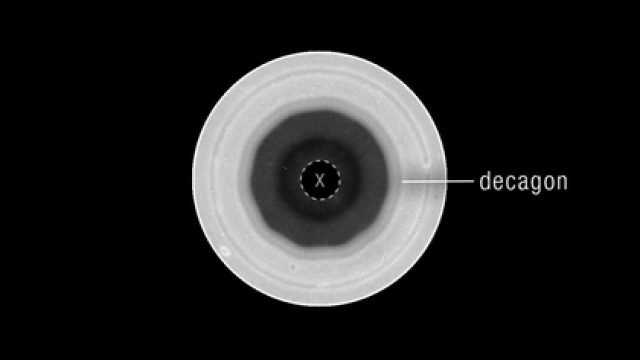
In a surprising development, astronomers have recently identified a decagonal shape forming around the southern hemisphere of Saturn. This intriguing ten-sided figure emerges as a wave in the planet's atmosphere, attracting significant interest from the scientific community. While Saturn has long been known for its stunning hexagonal feature at the north pole, the appearance of this new geometric formation signifies much more than just an aesthetic phenomenon; it may unlock secrets about atmospheric dynamics on gas giants.
The Emergence of the Decagon
Images captured from NASA's spacecraft reveal that this decagon is not just a static shape but a manifestation of active atmospheric processes. The formation's presence poses numerous questions: What does this mean for our understanding of Saturn's atmospheric behavior?
Scientists have noted that similar geometric patterns can occur in other planetary atmospheres, yet Saturn's case is particularly unique given its complexities. The decagon might suggest that Saturn is experiencing shifts in its atmospheric patterns, which could be linked to seasonal changes or alterations in wind currents.
Implications for Atmospheric Science
This discovery emphasizes the importance of atmospheric studies in planetary science. By examining shapes like the decagon, researchers aim to understand how gas giants such as Saturn manage heat and energy distribution within their atmospheres.
Moreover, the significance extends to comparative analysis with other planets, which may hold parallels in their meteorological phenomena. Understanding Saturn better allows scientists to create models that could predict atmospheric behaviors on exoplanets, expanding our comprehension of planetary systems beyond our solar system.
Future Exploration and Research
The revelation of Saturn's decagon opens new avenues for exploration and research. Future missions will likely focus on further scrutinizing Saturn's atmosphere, aiming to capture more detailed data about this ten-sided formation and its characteristics.
As technology advances and spacecraft capabilities improve, the potential for discovering other atmospheric phenomena on Saturn and beyond becomes more promising. Researchers are keen to understand whether this decagon is a temporary feature or indicative of long-term changes in Saturn's weather patterns.
Engagement from the Scientific Community
The scientific community is already buzzing with excitement over this latest finding. Conferences and collaborative studies are expected to emerge, focusing on atmospheric dynamics similar to those observed on Saturn.
This discovery not only enhances our knowledge of the gas giant but also emphasizes the synergy between observatories and space agencies. Collaborative efforts are essential to deepen our understanding and broaden the implications of such findings.
Conclusion
The emergence of a decagon around Saturn's south pole is a remarkable testament to the planet's atmospheric complexities. This discovery enriches our knowledge of gas giants and vividly illustrates the dynamic nature of planetary atmospheres. With planned future studies, scientists hope to uncover more about Saturn’s atmospheric phenomena, leading to breakthroughs in our understanding of planetary systems.