

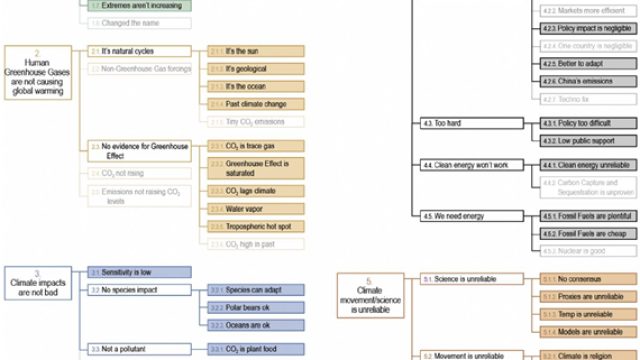
In an era where environmental issues dominate global discussions, a recent publication from Monash University sheds light on the flawed reasoning behind various contrarian claims about climate change. Supervised by the eminent John Cook, honours student Ruby Flack and her interdisciplinary team have created a significant contribution to the discourse on climate myths through their paper titled “Identifying Flawed Reasoning in Contrarian Claims about Climate.” This insightful study, published in Environmental Communication, serves as a critical resource for debunking misinformation in climate discussions.
The Importance of Clarifying Climate Myths
Understanding the various misconceptions surrounding climate change is crucial, especially in today's context where misinformation can easily spread through social media and other platforms. The study by Flack and her team systematically deconstructs claims that undermine climate science, thereby contributing to a clearer understanding of the facts.
Key Findings from the Paper
- Logical Fallacies Identified: The research presents a detailed taxonomy of logical fallacies found in contrarian claims, allowing readers to recognize flawed arguments more easily.
- Evidence-Based Approach: It emphasizes a rigorous examination of claims without asserting whether the arguments are inherently misleading.
- Broader Implications: The findings have significant implications for how society perceives climate change, which is essential for fostering informed public debate.
Why This Research Matters Now
As we navigate through ongoing climate discussions, the dissemination of accurate information is more important than ever. The urgency to tackle climate change demands clarity and truth in the dialogue surrounding it. This study offers a framework to critically assess the arguments posed by climate skeptics, which can be particularly useful for educators, policymakers, and advocates working towards sustainability.
Addressing Misinformation
Misinformation regarding climate change can lead to significant public misunderstanding, hindering legislative and social actions aimed at combating the crisis. The insights derived from Flack's research are vital for addressing these misconceptions head-on:
- Providing educators with tools to teach critical thinking.
- Helping policymakers to formulate responses based on sound scientific understanding.
- Equipping advocates with factual rebuttals to counteract misleading claims.
The Role of Interdisciplinary Collaboration
The success of this research underscores the power of collaborative efforts across various disciplines. By bringing together insights from environmental science, communication studies, and logic, the team developed a comprehensive approach to tackling contrarian views. This interdisciplinary model can serve as a blueprint for future research initiatives aimed at addressing complex global challenges.
Future Research Directions
As the conversation around climate change continues to evolve, further research is essential. Potential areas for future exploration include:
- Investigating the psychological factors that contribute to the acceptance of misinformation.
- Developing strategies for effective science communication in diverse communities.
- Evaluating the impact of social media on the spread of climate misinformation.
Conclusion
In conclusion, Ruby Flack's thesis, now a published paper, serves as a crucial resource for anyone engaged in the climate change discourse. By identifying logical fallacies present in contrarian claims, this research not only enhances our understanding of climate misinformation but also equips us with the tools necessary to foster a more informed and proactive society. As we face the pressing challenges of climate change, the need for rigorous research and clear communication has never been more critical. Engaging with these findings can empower individuals and communities to advocate for truth and sustainability in the face of adversity.